Wednesday, November 02, 2005

Flexi pavement...


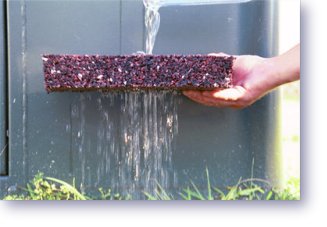
Now THIS is an interesting product! Found it while blogging http://www.ecosmartinc.com/catpavespecial.php. It is a recycled rubber product. Water goes right through it. It wears well. It is non slip. I wonder if it could be used as juitsu mats. Comes in several colours, can be used outside, and is reasonably inexpensive at under 8 bucks Canadian a square foot.

It is probably too heavy to use for armour. But I am thinking about padding for under the anvil...might cut the noise down a little!

Monday, October 31, 2005

Happy Halloween!


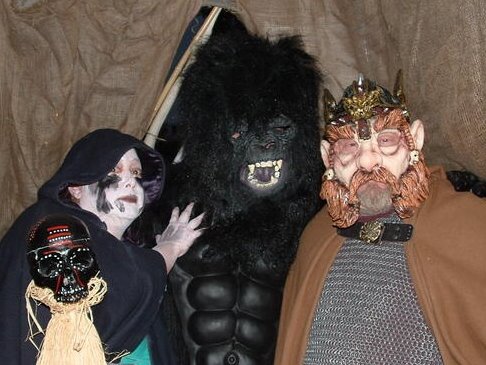
The pic is courtesy of StrangeCosmos.com A site which can't be visited nearly enough!
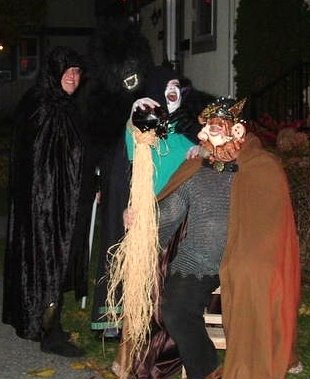
And WHY NOT! Its All Saint's Day tomorrow, and tonight, all the little ghosties and ghoulies were out trying to scare the homeowners our of their candy! Brenda and I went over to Shayne's place, where he "does" Halloween in a big way....his front yard is decorated in skulls (some 27 of them by my count) including a complete cage with the skeleton of a dead pirate in it, dangling over the front sidewalk! He dressed up in his head to toe Gorilla suit, and fired up his light saber every time a kid didn't say "thank you". Tried to keep from scaring the VERY young though. They scare easy, and this was supposed to be a fun little "OMG" sort of shock, not a "bwaaaaaaa....daddddddddeeeeeeeyyyyyy" kind of fright. So we were careful.
Lots of parents with their kids. Good to see. I would just be a piece of the decoration, standing there in my mask and cloak, and the parents were too busy watching their kids getting scared to realize I was right behind them. sometimes people would jump when they realized I was actually alive! I thought it would be kind of fun to tap on their shoulder, and when they turned around, they would see Shaynes' voodoo "skull on a stick". That got some shreiks from the parents!
Yup, that was a success.

Shayne and Cindy took some pics and I'll try to put them up here when they have got around to downloading them and sending them to me.

Saturday, October 29, 2005

Halloween Scary things....


The most scary thing I have been up to this Halloween weekend is to nail up shingles on my roof. At least it isn' t a 12 in 12 pitch,but it is close....about 9 in 12. That is just a little too steep to stand on! Oh when will I ever learn to build roofs that are not so darned steep! My knees are raw, my insteps are stretched like rubber bands (cept rubber bands don't hurt that bad!) I believe that putting up shingles is pretty nearly one of my most hated jobs.
Ah well, it looks good though.


Finish this off tomorrow, and then carve out some pumpkins. I have not done a Jack 0 Lantern in years! Of course, come next Tuesday, we'll be taking our Katana's out for some pumpkin carving. This should be fun!

Wish I was at your party Zlanth.....but seeing as how I have the flu it is probably best that I stay home. I'll hoist a brewski in yer honer though. I always get the flue after I get a flu shot. They say you can't get the flu from the flu shot...its dead! Hah! I think it just kicks the crap out of your immune system so that you pick up whatever galloping lung rot happens to be in the air at the moment! So, I taught my class in a whisper last night, and today, there is NO voice left at all. Singing in the shower is an exerience...I have to turn the water off to hear myself!

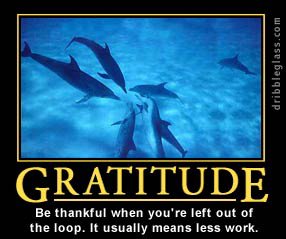
Well, I suppose I should be grateful for small things....the fact that I CAN actually climb on a roof and hit nails. (I notice that as I write this that there is a little twinge of pain everytime I hit the T, G, B , F, R and V. Clearly not every nail I hit with the hammer was made of steel!) I have posted a wonderful pic of Gratitude. Thanks, Dribbleglass!

Sunday, October 23, 2005

How to play hockey! OMG!


Pirate asked me to explain how to play hockey! Gosh, for me, that is like asking me how to explain breathing! But, I can do this!

How to play hockey....
Get a bunch of guys to play on the road in front of your house. eight to ten kids is enough, more is better. Place a couple of easily moved objects down about a body width apart to form the "net", backpacks full of school books are good. Place two nets, one on each end of the "rink". You will also need sticks of some kind that you can tape "blades" onto....foot long thin boards which stick out at an angle at one end of the stick which you can use to bat the rubber ball around. We used to tape broken sticks from our older brothers teams together to make a whole "customized" stick for ourselves. Divide up into teams, and try to knock the rubber ball or old torn up baseball into the "net". One player is allowed to be the "goalie" for each side, and he will try to stop you from getting the ball through his "crease" and into the "net". Under your pant legs, you stuff magazines held onto your shins with sealer jar rubbers (if you can still GET sealer jar rubbers!) or elastic bands....that will serve as shin armour. I used inner tubes cut into rings, or else "hockey tape", a black gooey version of surgical tape.

Make the rules up as you go along, don't hit the other guys enough to leave too many bruises, (remember, what goes around comes around) and have a blast! When a car comes up, it will stop. The goalie yells out "CAR!", play is stopped, the backpacks are moved, and the car moves carefully through. The backpacks get put back into service and play resumes.
Have a blast!

Of course, as you get older, you might start skating. Inline skates on concrete, or ice skates on ice. Inline hockey hurts more as you slide along the concrete.....You can learn a few more rules, join a league, and play on an actual ice surface. The speed gets a lot higher! You get together in actual "teams" and "play position", play for 3 periods plus OT, and of course,
you have a blast!

In Canada, Saturday night is "hockey night in Canada", the name of a CBC show which is VERY popular. I have seen weddings end early so the guests could catch the game! The game of hockey has defined Canadians as much or more than baseball has defined those south of the 49th parallel, providing a powerful and much needed unifying force.
The NHL, (the National Hockey League) went on strike last year, and the owners locked them out for an entire year. This has caused untold misery among fans who don't know what to talk about when they go out to a tavern for a pint. Now that the season is "on again!", the angels are singing, Molson Brewery stock is up again, wives can get together with other wives and complain (commisserate? celebrate?) about being hockey widows and all is right with the world.
More ice hockey info is below.
http://www.fitness.gov/ice_hockey.html
http://www.firstbasesports.com/hockey_glossary.html
and this from the wikipedia....http://en.wikipedia.org/wiki/Ice_hockeyIce hockey, known simply as hockey in Canada and the United States, is a team sport played on ice. It is one of the world's fastest sports, with players on skates capable of going high speeds on natural or artificial ice surfaces. The most prominent ice hockey nations are Canada, United States, Russia, Sweden, Finland, Czech Republic, and Slovakia.
In all there are 64 members in the International Ice Hockey Federation. As one might expect, its worldwide popularity is concentrated primarily in locales cool enough for natural, long-term seasonal ice cover. It is the official national winter sport of Canada, and it has a strong enough following in certain regions of the United States (notably the Northeast, the Northern Midwest, and Alaska) that many Americans consider hockey to be a "major sport" in their country as well, although some Americans from other parts of the U.S. dispute hockey's inclusion as a major sport. The parts of North America which have the strongest followings of the sport are often called "hockey country".
While most of the countries mentioned above have their own professional ice hockey league, North America's National Hockey League is considered the world's premier professional ice hockey league and attracts almost all of the world's elite players.

Is it just me or is that driver blind?


Blind Referees. Blind outfielders. Blind swordsmen! Blind drivers! This in from the Manchester Online....one of the finest tabloids in the World! http://www.manchesteronline.co.uk/cars/news/s/177/177438_blind_driver_sets_speed_record.html

Mike Newman, from Sale, Cheshire, raced to 167.32mph in his specially-made BMW M5 at Elvington Airfield, near York.
Organisers of the event said the record was set after the average speed was taken from two runs at the Yorkshire airfield earlier today.
He was hoping to break the 200mph barrier but was thwarted as he ran out of room on the track.
He said: "It has been a wonderful day. It has been a really exciting day. Hopefully I have raised awareness ahead of World Sight Day and shown that you can achieve anything you want."
Mr Newman set a record of 144mph in a Jaguar XJ-R in August 2003.
But he hopes today's new record will increase awareness and much-needed funds for his chosen charity, Vision 2020, ahead of World Sight Day later this week.
John Galloway, who helped organise today's record attempt, said: "This is a marvellous achievement. Mike drove totally unassisted. It is a fantastic achievement and has been one of the most emotional days of my life."


Hah! I am sure I was following this fellow down the 401 highway last Thursday!

Thursday, October 20, 2005

The good old hockey game...the best game you can name...

I made a post on Jen's comments that was so good that I just had to repeat it here!

Ah, now Jen, when a hockey team ties up after three periods, the game goes into "sudden death overtime". These guys who have been skating like crazy for the last 20 minutes trying to score to avoid just this situation look at their team mates trying to suck enough wind to survive, down at their trembling, rubbery legs, and try to clear eyes blurry from fatigue and sweat. The game goes into overtime, and the game is won in the line changes...if the coach can change his people over during play without leaving too few people on the ice. All considerations of strategy and trying to match up teams against the opposing team goes right out the window, its a matter of "who can drive their body for another 30 seconds drive to the goal!?" Because the first side to score a goal wins the game. The referees mostly just try to stay out of the way....fouls and infractions take too much energy at this point for anybody to commit them, and if they did, their coach would yank them for good for delaying the game. Besides, the players are too tired to play a crisp game anyway, it is nothing BUT fouls, mostly by accident, tired players stumbling over their sticks, their own feet, their opponent's feet, over a shadow on the ice..., no point in getting upset about it.

Now... the goalies have to earn their pay. Shaved ice from skates getting dangerously dull coat them from head to toe, and it is freezing to their clothing, their hair, their masks. The goalie has to see through the sprays of snow (from people stopping just short of his position) and the sweat trickling into his eyes from the tension and the exertion of moving 50 pounds of padding from "here" to "there", when "there" is a tiny little puck coming in at 80 miles per hour. The ice is chopped and cratered outside of his crease causing even experienced skaters to trip and crash down into a melee of flying blades, elbows and splintered sticks, quite possibly bringing the goalie with them.

There is no heckling, shouting at individual players...they can't hear you anyway over the noise of a crowd going wild, not to mention the pounding of their heart beats, and raspy breathing. Any comment they could make would be short, almost in code..."Pass to you...Rob, got that?...change out Pat...." and of course "ooofff, you son of xxxx that was a cross check! Oooh, my ribs..."

This is when the goalie shines though. Not for him the glory of scoring points, only the panic of seeing 8 men in various colours of uniform charging in on him in the fastest game on earth.

Kind of boring, actually. I mean, how can that honestly compare to watching the outfielder trying to find a place to squirt his tobacco juice, or scratch his groin without a camera catching the act.
Just kidding...I rather enjoy PLAYING baseball. For me...its hard to watch though.

Wednesday, October 19, 2005

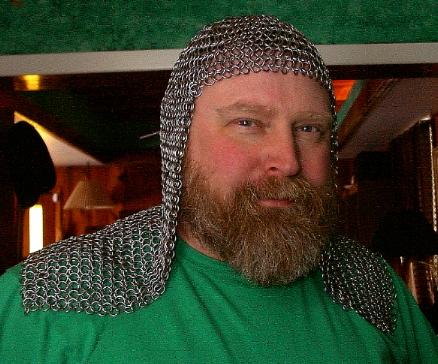
Chain Mail


Don't I look terrifying!
This is a stainless steel coif I made for a fellow who loves the wrestler "Big Poppa Pump" . He had gone to a bar to watch the wrestling, and woke up the next morning without his wallet, his coif, his "raiders" jacket and his shirt.

Lesson learned...watch your drinks....

Tuesday, October 18, 2005

Motivation


I am having such a difficult time getting motivated this morning. So I figured all I would need to do is to get up onto this here in-ter-net thingy here, and find some motivational pictures. Fortunately, there is lots to choose from! I have no idea who made these signs up....I pulled them off of "DribbleGlass dot com", but I don't know where they got them from!

Now I feel much better, and ready to start my day!

(I think Dribble Glass is one of the few "joke" sites that isn't full of viruses, spy ware and other little surprises! I drop in there once in a while just to reset my humour engine!)


Monday, October 17, 2005

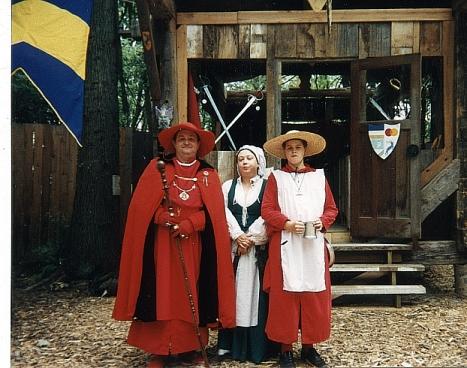
Ren Faire


A retrospective picture of my sales booth at the Ren faire, what...6 years ago!

Thursday, October 13, 2005

Weird Facts from EatYourMakup@blogspot.com

<<::Weird Facts::>>
This are some interesting facts I found that some chick researched. I found it humourus.
If you yelled for 8 years, 7 months and 6 days you would have
produced enough sound energy to heat one cup of coffee.
(Hardly seems worth it.)
If you farted consistently for 6 years and 9 months, enough gas is
produced to create the energy of an atomic bomb. !
(Now that's more like it!)
The human heart creates enough pressure when it pumps out to the
body to squirt blood 30 feet.
(O.M.G.!)
A pig's orgasm lasts 30 minutes.
(In my next life, I want to be a pig.)
A cockroach will live nine days without its head before it starves
to death! .
(Creepy)
(I'm still not over the pig.)
Banging your head against a wall uses 150 calories an hour
(Don't try this at home, maybe at work)
The male praying mantis cannot copulate while its head is attached
to its body. The female initiates sex by ripping the male's head off.
("Honey, I'm home. What the....?!")
The flea can jump 350 times its body length. It's like a human
jumping the length of a football field.
(30 minutes..lucky pig! Can you imagine?)
The catfish has over 27,000 taste buds.
(What could be so tasty on the bottom of a pond?)
Some lions mate over 50 times a day.
(I still want to be a pig in my next life...quality over quantity)
Butterflies taste with their feet.
(Something I always wanted to know.)
The strongest muscle in the body is the tongue.
(Hmmmmmm......)
Right-handed people live, on average, nine years longer than
left-handed people.
(If you're ambidextrous, do you split the difference?)
Elephants are the only animals that cannot jump.
(Okay, so that would be a good thing)
A cat's urine glows under a black light.
(I wonder who was paid to figure that out?)
An ostrich's eye is bigger than its brain.
(I know some people like that.)
Starfish have no brains.
(I know some people like that too.)
Polar bears are left-handed.
(If they switch, they'll live a lot longer)
Humans and dolphins are the only species that have sex for pleasure.
(What about that pig??)

Tuesday, October 11, 2005

Eventful weekend...


Got a helm sent off. This is what it is supposed to look like. Instead I seem to have forgotten everything I ever knew about making this silly helm. I didnt bother to read my notes on the templates, its just a barrel helm right? I made what...a couple of dozen of them in my career? Well, after I made it, it didn't really look right, so I looked up barrel helms I had done in the past. Yup, I had made big basic design errors. I put the top on the outside instead of the inside, the bottom part got put on top of the upper part, the face plate was symmetrical, the crosses were sqare instead of circular, and there were two of them instead of one! All in all, a shambles. Is it common to forget how to do things, even simple things like making a simple barrel helm like this?
Fortunately, the helm I made is functional, but honestly, I will have to pull up my socks and pay more attention to what I am doing.

The bus station this weekend was a zoo! What fuel crisis? 60 taxi drivers idling their engines up St. Catherines street! I hate Thanksgiving weekend...all the crowding and noise with none of the "Good Cheer" of Christmas. Canadian Thanksgiving is in the pissiest time of year too...October !! No leaves have fallen yet, summer is definely over, but fall is not really here. I have heard this is a good time of year to go diving!

All these things seem so petty when I watch footage from Pakistan. My heart breaks when I hear of schools which have collapsed and think of the families frantically dragging at the wreckage with their bare hands to get to the children crying out with pain down inside. Or worse, hearing the crying stop! In the midst of all this human misery, there are politics....which is fodder for another post!

Well, back to work, make a "good" barrel helm this morning.

Wednesday, October 05, 2005

The ride to Pembroke

Looks like the College has decided to meet my price and will pay me to drive all the way to Pembroke, teach a four hour class, put me up for the night, and teach another 4 hour class the next night! For the price I demanded! You got to remember, its a 3 hour drive. In Winter. In Canada.
Now, this is a class on how to fight with a sword! The class is not nearly as dangerous as the drive! Fortunately, its a drive on a major commuter route, so it should be free of snow and ice. mostly.
I'm actually quite tickled at this, not least because I know I will be teaching mostly military guys from the big army base right there. I like teaching military...when you tell them to listen up, they, like, listen up! Wonderful!

Next trick of course is figure out how to make this a very attractive class. Promotional materials, and so forth. Should be interesting, I am not really good at promoting myself....not that I am shy, (nobody thinks I am shy!) but I really don't know where to start! When we decided to promote the class at the College, we watched as different departments formed little kiosks and displayed books of "what we do" to interested students. Jean and I looked at that setup in amazement, and proceeded to bring in suits of armour, swords, and a live display! I suspect it was this display which has resulted in the course being so amazingly popular. But I cannot do that at a venue three hours away, so I am sort of wondering how to do it.

So why (you may well ask) am I promoting myself instead of having the college doing it for me. Isn't that what they are paid to do? Well....actually, after watching the Ren Faire collapse due to insufficient promotion, I am nervous about hitching my wagon to somebody else' s promotional horses.

Well, looks like my work is cut out for me this morning!

Saturday, October 01, 2005

Harry Reems has a message!

The first of the great porn stars....before John Holms of course....is now 58 years old, a real estate broker, and a Methodist. (Also monogamous, and unusual for a Methodist, a small "L" liberal. )

http://jam.canoe.ca/Video/DVD_Column/2005/10/01/1243476.html

Now he has a message. His DVD just came out, and he explains how awful the life was, how he almost died/went broke/drunk. Get this...it took Hugh Hefner (That Emissary of Satan!...that evvviiiilll man!) to get him into a 12 step program and turn his life around.

So, what's his message? Well censorship is still wrong, beware of people who think they know what is right from wrong, and to quote him "The only story I wanted to tell was the story of redemption. And, indeed, the two filmmakers of this documentary saw the same story and we have the same fix, so I agreed to co-operate in it. And now, quite frankly, I'm being paid quite well to promote the film and to promote the DVD."

So, he is "test-a-fyin". And getting paid quite well do do so.

Gosh Rev-ed, you were agonizing about a glass of wine, and here is a fellow who virtually established the sexual revolution, saying quote..... "No, no, no! In fact, if I were asked if I would do it all over again and I knew I was going to be the person I am today, I'd do it in a heartbeat. There was a lot of pain and angst and suffering, especially right after the trial (he was singled out and prosecuted for his role in Deep Throat before being freed from the ordeal by the Jimmy Carter administration) and until I got sober in 1989, but I'd do it all over again." Yeah, I bet you would Harry! Those memories will never die! And what happens to the girls....oh, I guess that doesn't matter, its all about you!

I don't know whether to envy him or despise him. Either way, ya gotta admire somebody who took the lemons life handed him and made lemonade! Looks like you have turned your life around, so it is unfair to chastise you for your earlier life, but darn it...I'm a gonna tease you unmercifully!

Tuesday, September 27, 2005

Don Adams,Dead at 82

Sorry about that Chief!

Well, would you believe....

Go Go Gadget legs!

The depressing news that Don Adams is dead is the perfect topper of a dreadful week.
http://jam.canoe.ca/Television/2005/09/26/1236535.html

In a 1959 interview Adams said he never cared about being funny as a kid: "Sometimes I wonder how I got into comedy at all. I did movie star impressions as a kid in high school. Somehow they just got out of hand."
In 1941, he dropped out of school to join the Marines. In Guadalcanal he survived the deadly blackwater fever and was returned to the States to become a drill instructor, acquiring the clipped delivery that served him well as a comedian.
After the war he worked in New York as a commercial artist by day, doing standup comedy in clubs at night, taking the surname of his first wife, Adelaide Adams. His following grew, and soon he was appearing on the Ed Sullivan and late-night TV shows. Bill Dana, who had helped him develop comedy routines, cast him as his sidekick on Dana's show. That led to the NBC contract and Get Smart.
Adams, who married and divorced three times and had seven children, served as the voice for the popular cartoon series, Inspector Gadget as well as the voice of Tennessee Tuxedo. In 1980, he appeared as Maxwell Smart in a feature film, The Nude Bomb, about a madman whose bomb destroyed people's clothing.

Sunday, September 25, 2005

Friday, September 23, 2005

Women are like apples, Men are like grapes

Apples and Wine

Women are like apples on trees.
The best ones are at the top of the tree.
Most men don't want to reach for the good onesbecause they are afraid of falling and getting hurt.
Instead, they just take the rotten apples from the groundthat aren't as good, but easy.
The apples at the top think something is wrong with them,when in reality, they're amazing.
They just have to wait for the right man to come along.
The one who's brave enough to climb all the wayto the top of the tree.
Men... Men are like a fine wine.
They begin as grapes and it's up to womento stomp the shit out of them
until they turn into something acceptable to have dinner with

thanks to http://hyuppie.blogspot.com/2005/08/apples-and-wine.html

Thursday, September 22, 2005

How true to history was the "Last Samurai"?

This cut and paste was pulled from Mr. Dresner's history forum. Here is the URL. I felt that Mr. Dresner would not object to this publication providing that I not only credit him full, but publish it its entirety. Is a bit long. Might I suggest that you check out Mr. Dresner's forum for yourself, and read the comments. Some of the comments are even longer. Its great fun!

http://hnn.us/articles/2746.html

How True to History is Tom Cruise's The Last Samurai?
By Jonathan Dresner
Mr. Dresner is Assistant Professor of East Asian History at the University of Hawai'i at Hilo. His research examines Meiji-era (1868-1912) social history. And he is a member of the HNN group weblog Cliopatria.
From the opening voiceover and title to the final scene, The Last Samurai is an historical disaster. I expected it to be bad, based on early reviews (e.g. Paul Dunscomb's social critique and Tom Conlan on samurai mythology and discussions on H-Japan). This isn't surprising, of course: popular representations of historical circumstances are often badly done. But this is distinctively and truly awful. There was real drama and adventure in late nineteenth century Japan that could have been even more powerful, but instead we get a pastiche of Dances With Wolves , Karate Kid , Kagemusha and Shogun .
A quick summary of the movie for those who haven't seen it. Yes, I'm going to give away the ending, but if suspense is what interests you, this is the wrong movie anyway: there is almost nothing about the plot or characters that is surprising or original. In 1876, Nathan Algren (Tom Cruise), a PTSD victim who was once a U.S. cavalry captain under Custer, is hired by Japanese industrialist/politician Ōmura (noted actor/director Masato Harada) to train Japanese military conscripts for combat against a gathering storm of rebellion by "the samurai" who do not wish to modernize their ways. In an early skirmish he is injured and captured by the rebels, and recovers in their mountain village encampment over the course of the Fall and Winter when the snows cut them off from the outside. (This begins the Dances With Wolves section.)
As he recovers, he gains remarkable facility with the language -- and the rebel leader Katsumoto (Ken Watanabe) speaks excellent English -- and becomes impressed with the purity and simplicity of the samurai way ( bushidō), not to mention getting really good at Japanese-style armed and unarmed combat (that's the Karate Kid part). Algren joins Katsumoto to lead the rebels against the Imperial forces trained and led by his former commander (Tony Goldwyn, not Custer, but representing the same mindset). Though the rebellion is tactically innovative, the rebels are limited by their adherence to traditional weapons and are obliterated by modern military technology. (Kagemusha, though in that story the leaders were taken by surprise and had the good sense to be horrified at the slaughter of their followers.) Their purity of spirit and devotion to duty nonetheless moves the Japanese Emperor (the Kabuki-trained Shichinosuke Nakamura II), once a student of Katsumoto, to reject a U.S. arms-for-trade treaty brokered by Ōmura. Algren then returns to Katsumoto's village to take up with Katsumoto's sister, Taka (Koyuki), and her children, whom he has converted from hatred (since he killed the man of the house in the course of getting captured) to deep affection with his simple honor. ( Shogun 's romantic plotline was equally implausible, though for different reasons.)
To be fair, some of the background to the story is reasonably true to life. Japan in the 1870s was in the throes of industrialization and radical social and political changes, the process we used to lump together as "modernization." There were samurai who objected to the changes that directly affected themselves, some of whom took up arms in rebellion (more about that below). There was even a plot to assassinate the historical analogue of Katsumoto (though it certainly did not involve a corps of crossbow-wielding ninja). Westerners in 1876 generally considered the Japanese to be an uncivilized people, inferior to Caucasians in culture, intelligence and character. The Japanese government did pay extravagant salaries to foreign experts in fields ranging from history and law to military technology and technique who could teach Japanese to be experts in those fields. Most of those Westerners spent a few years in Japan and then returned to their homelands. Some Westerners, though, became so enamored with Japan that they remained and became quite expert at Japanese culture, even living and dressing in Japanese style. The Meiji Emperor was indeed a young man (about 25 years old in 1876-77) who was largely a puppet of his advisors.
The score will probably get nominated for an Oscar, though its predictable pseudo-exoticism -- wooden flute and twangy strings leavening an otherwise competent musical backdrop -- is a pretty good metaphor for the entire film. The costumes and sets and scenery and military hardware are precise and proper and the swordplay is first rate (aside from some highly implausible sword-throwing). Even the Japanese language material was fine, though the subtitles were idiosyncratic. The consultants (including Mark Schilling, who chronicled his experience in the Japan Times) did their jobs well enough. And I'm pleased that they showed even a brief snippet of kyogen (comic theater) or a country variation, including participation by the leader Katsumoto. Japan 's deep tradition of humor, including slapstick, sexual and situation humor, is too often lost in the haze of "serious" traditions like Zen and samurai and Nō.
The acting is mostly competent, though there are some standouts. One of the best roles in the film is played by Seizō Fukumoto. Fukumoto is a four-decade veteran of Japan 's samurai and yakuza movies, describing himself as a kirareyaku -- literally, "the actor who gets cut," whose main role is to be killed by the hero in a climactic fight scene. In The Last Samurai he is "The Silent Samurai," whose wordless watchfulness draws Algren's ire and derision, but whose martial skill and valor are undeniable by the end. Though standard Japanese TV samurai dramas are a little less bloody than this film, they feature most of the same good qualities: historical scenery, redemption through honor, and neat swordfighting. When I lived in Japan , my favorite regular hour of TV was Mito Kōmon , the tale of the retired daimyō lord and his samurai retainers who travel the countryside incognito, righting wrongs. I wonder why more of them haven't been made available in the U.S., when there is clearly an audience.
The movie actually gets some of the deeper historical context right, probably accidentally: After a decade of intense social and economic change, the Imperial government in the 1880s began a deliberate program of moral and ethical and historical propaganda, the aim of which was to instill in Japanese a sense of unity centered on the Emperor, particularly on his mythological status as a "living god," a direct descendant of the deities which created Japan. (see, for example, the preamble to the 1889 Constitution) The tropes and themes of this newly constructed nationalism were drawn from Japanese Confucianism, Bushidō and Shinto, with a bit of Prussian constitutionalism for legal structure, and it was transmitted through the most modern institutions of the day: the national education system and the military. This retention and reinvention of tradition led pretty directly to Japan 's imperialist expansion into Asia and the Pacific, so it's a little hard to see the ending of The Last Samurai as a victory for good and right.
Another accidental truth: the Satsuma rebellion, and quite a few of the other samurai rebellions, were rooted in the inability of those samurai to envision duty and honor without status, or to be a part of a nation striving for growth rather than a privileged class with inherent qualities. In this movie attachment to the symbolism of the sword trumps the fulfillment of duty, or common sense. In the real history, a few thousand samurai's belief in their moral superiority as a class, their refusal to relinquish the privilege of offering special service to the nation, and their attachment to the symbols of the past, trumped participation in the political and technological growth of Meiji Japan. But hundreds of thousands of samurai -- the samurai class was about 5 percent of a population of thirty-five million -- transformed their sense of duty and purpose into new forms, serving in national and local governments, working as police, military officers, and teachers, and investing their time and energy and wealth in modern economic development.
What's wrong with this film, then? Well, almost everything else, starting with the basic premises of the plot. Stephen Hunter's deconstruction of Cruise's Algren character is singularly thorough. Japan did use U.S. surplus military equipment, particularly around the end of the U.S. Civil War (1861-1865), but by the 1870s Japan had settled on other models: the British Navy and the Prussian Army (they had started with the French model, but switched in 1871, though they continued to use French officer instructors for a few years). So it is highly unlikely that the Japanese would have hired an American.
By 1876, the Imperial Army was, indeed, a conscript army, but had a strong core of volunteers, mostly samurai, and a pretty well-defined training program. They were not using primitive muzzle-loading rifles at that point, either. Japanese commoners, who are so inept at the beginning of the film that they literally can't shoot if their lives depend on it, had proven quite adept with military technology in the 1860s, when small mixed samurai-commoner militias with breech-loading and repeating rifles defeated much larger Shogunal forces still heavily reliant on traditional spear, sword and arrow weaponry. Those militias formed the core of the post-Meiji Restoration (as the 1868 transition is usually called) Imperial Army. And Imperial forces had a few adventures in the 1870s, including the Taiwan expedition (1874) and the mission to secure the Kanghwa Treaty in 1876, not to mention suppression of a number of domestic disturbances, including both samurai and cultivator uprisings.
The rebellion led by Katsumoto in the movie is supposed to be a scaled down version of the 1877 Satsuma Rebellion led by SAIGO Takamori. It's a shame that the moviemakers didn't take that more seriously, because the uprising, known in Japanese as the "Southwestern war," was a true crisis. Every resource of the new government was called upon, including its modernized shipping lines, rail transport, police forces (who were reorganized into military units), samurai volunteers, officer trainees, and fiscal reserves (the Matsukata Deflation of the early 1880s was partly necessary because of the excessive costs of putting down the rebellion). The rebels, protesting the loss of the traditional privileges and domainal autonomy, were quite well-armed, having seized several local armories early in the uprising: many of their officers were trained in modern methods, and they led both artillery units and riflemen. The rebels were only outnumbered by two-to-one; there wasn't a long, tense run-up to the conflict, as the movie insists; Saigo Takamori was not the leader at the beginning; and the fight ran constantly from February through September, rather than being a pair of battles separated by winter storms. There were other samurai uprisings in the years leading up to the 1877 Satsuma Rebellion, some of which actually resemble the movie more closely, at least in terms of scale and the ease with which they were suppressed. But none of the others were led by men who had been Imperial advisors, as Saigo had been. After 1877 there were no more samurai uprisings. (For more details on Saigo, see Mark Ravina's biography, The Last Samurai: The Life and Battles of Saigo Takamori, which is currently selling considerably better than the official movie guide.)
One intriguing element that the film could have exploited but didn't was the analogy between the Native American tribe and the samurai clan. Very different social institutions, of course, but historians of Japan have long recognized that the failure of samurai rebels to ally across clan lines in the Meiji era (1868-1912) doomed them to failure against the increasingly coherent national polity. Domainal loyalties plagued Japanese politics and military affairs well into the twentieth century. But the movie clearly can't differentiate between the individual samurai clan and the samurai class. The vast majority of Japan 's ruling elites, the modernizers who are so thoroughly evil in the film, were also samurai (many of them from Satsuma), who made the decision to eliminate their own aristocratic privileges. The vast majority of samurai did not protest, did not rebel, and were rather relieved to be freed from the samurai restriction on earning an honest living to supplement their increasingly meager official stipends.
The most blazingly bad bit of history has to do with the arms-for-trade treaty, and I'm surprised that more commentators haven't noted this. The U.S. didn't need to parlay its military technology for trade advantages in Japan . From 1858 to 1899, U.S. trade with Japan was governed by the 1858 Japan-U.S. Treaty of Amity and Commerce, sometimes known as the Harris Treaty after U.S. ambassador Townsend Harris (played by John Wayne in The Barbarian and the Geisha ). That agreement fixed Japan's import duties at a very low level, established the right of Americans to practice their religions freely and to be tried in non-Japanese courts for crimes committed in Japan, and is considered the first of the "unequal treaties" that clearly established Japan as an inferior nation to the Western powers. The Most Favored Nation clause in the earlier Kanagawa Treaty (1854) meant that this was just a starting place: the U.S. would get every advantage negotiated by any other country with Japan . The Japanese were not in any position to make demands or set conditions in their foreign affairs: they spent three decades proving to the Western powers that they were a "civilized" nation that deserved more equal treatment. U.S. diplomatic treatment of Japan was heavy-handed and unpleasant, but it wasn't tawdry in a grovelling, money-grubbing way; it's bad enough, I guess, that the only American with any depth is the one turning samurai (the other respectable caucasians are British and Irish), but there's no need to pile on indignities.
There are a few minor points which I can't just let slip by:
The title of the movie is The Last Samurai but the Japanese ideograph which overlays it just says "samurai."
The opening voiceover refers to the creation of the Japanese islands by a divine sword, which was dipped into the ocean and dripped foam, but every version I've ever seen of Japan's founding myths describes the creation of a single island by foam dripping off of a spear, with the rest of the islands birthed by the gods. Swords don't come up until later.
The Meiji Emperor didn't speak English, and nobody outside of the most senior advisors saw him without an invitation. And he certainly didn't make important political decisions on the spur of the moment.
The Ōmura industrialist/politician character is difficult to pin down historically. He might be an amalgam of political heavyweight ŌKUBO Toshimichi, the younger but more radical and economically connected ŌKUMA Shigenobu, with some of the Mitsubishi founder IWASAKI Yatarō thrown in. Industrialists did not have the Emperor's ear (they didn't need it, having close ties to the samurai oligarchs) and Imperial advisors did not jaunt off to other countries to conduct job interviews.
Most samurai lived in large urban areas, though low-ranking Satsuma samurai were some of the few who lived in the country and also farmed. Even then, nobody lived in the mountains if they could avoid it.
The method of "no mind" is not "The Force" -- simply a matter of clearing one's mind of distractions and then the right thing will happen. It is a Daoist concept, originally, which became part of the martial arts tradition in China , then in Japan and elsewhere. It is a function of training constantly (certainly over more than four months) so that one can react instinctively, automatically, to a rapidly developing situation. Effortlessness comes after lots of hard work. The Karate Kid got that part right, actually.
The notion that the samurai have been "protectors of the nation" for nine hundred or a thousand years (and Katsumoto uses both figures) is absurd: the samurai began as rent collectors and estate protectors for the Kyoto nobility, and evolved into an aristocracy in their own right. Only against the Mongols (1274, 1281) can they be considered protectors of Japan ; it's highly unlikely that Katsumoto's clan was in one place that entire time; very few samurai clans survived the century-long civil war (15-16c) and most of those were relocated in the late 1500s. The Shimazu family which ruled Satsuma did originate in the 11th or 12th century, but Saigo Takamori wasn't a Shimazu. Like most samurai, his family attained warrior status in the 1500s and were unremarkable low-ranking retainers until Saigo.
Taka, attempting to refuse Algren's help with housework, says that "Japanese men don't do that." But many Japanese men did a great deal around the house, just not samurai. The Japanese very rarely referred to themselves as a collective, particularly on cultural matters, as early as 1876-77.
When they eat, they are consistently shown eating fluffy white rice, but only the wealthiest Japanese ate that regularly, and certainly rural samurai would have been more likely to eat rice gruel and other grains like barley and millet and buckwheat, either as gruel or as noodles, that grow better in upland conditions. And the movie glosses over Algren's introduction to chopsticks, which is not an insignificant event in acculturation.
By 1877, very few Japanese would have been particularly frightened of samurai, even samurai as backwards as Katsumoto's band, nor would they have bowed en masse. Urban Japanese had gotten over treating common samurai like daimyo lords a long time before.
Even allowing for Algren's remarkable immersion in Japanese language and culture, the likelihood is pretty small that he'd have run across the Japanese term for "President" in a rural samurai village, but that doesn't stop him from understanding the term when it comes up in a crisis.
Algren's first experience with armor on the day of the climactic battle is pretty implausible. Even allowing for superior physical conditioning and excellent training and the fact that Japanese armor is light and flexible relative to its Western analogues, there's almost no way he wears it as comfortably as he is shown.
The samurai warrior-cherry blossom (sakura) motif is so clichéd that I was surprised that it came up at all, and nearly laughed out loud when it came back just in time for Katsumoto's death. Judging by color, the blossoms were plum, not cherry.
Does it matter? Perhaps not. Perhaps it's too much to expect that our entertainments have a factual basis. But now I have to deal with the aftermath, with students who will think that all samurai (all five hundred of them, instead of nearly two million) were pure warriors who lived in the mountains, instead of as underemployed urbanite bureaucrats. I have to explain how rare seppuku (ritual suicide, also known as hara-kiri) was, how tenuous the samurai sense of loyalty, how the Japanese did not "Americanize," and I have to hope that my careful deconstruction can make some dent in the technicolor, surroundsound, adrenaline-enhanced images in their minds. The Meiji transformation of Japan is one of the most dramatic social and economic periods in modern history, and it ties directly to some of the most important turning points and processes of the twentieth century and present. But instead, The Last Samurai is another barrier to understanding, a step backwards in our collective education.
Note: Japanese names are traditionally written with the family name first; the movie credits put the family name last and I follow that for the cast members, but for the names of Japanese historical figures I have put the family name first and in all capital letters on first appearance: e.g. SAIGO Takamori.
Related Links